Characteristics of a good crimp
- All individual wires lie inside the conductor crimp, none outside
- The insulation ends in front of the conductor crimp and is held by the insulation crimp
- The stranded conductor is visible but does not protrude too far beyond the crimp
- Crimp height and crimp width are within the tolerance of the contact manufacturer
- No burrs, cracks or deformation on the contact
Crimp height
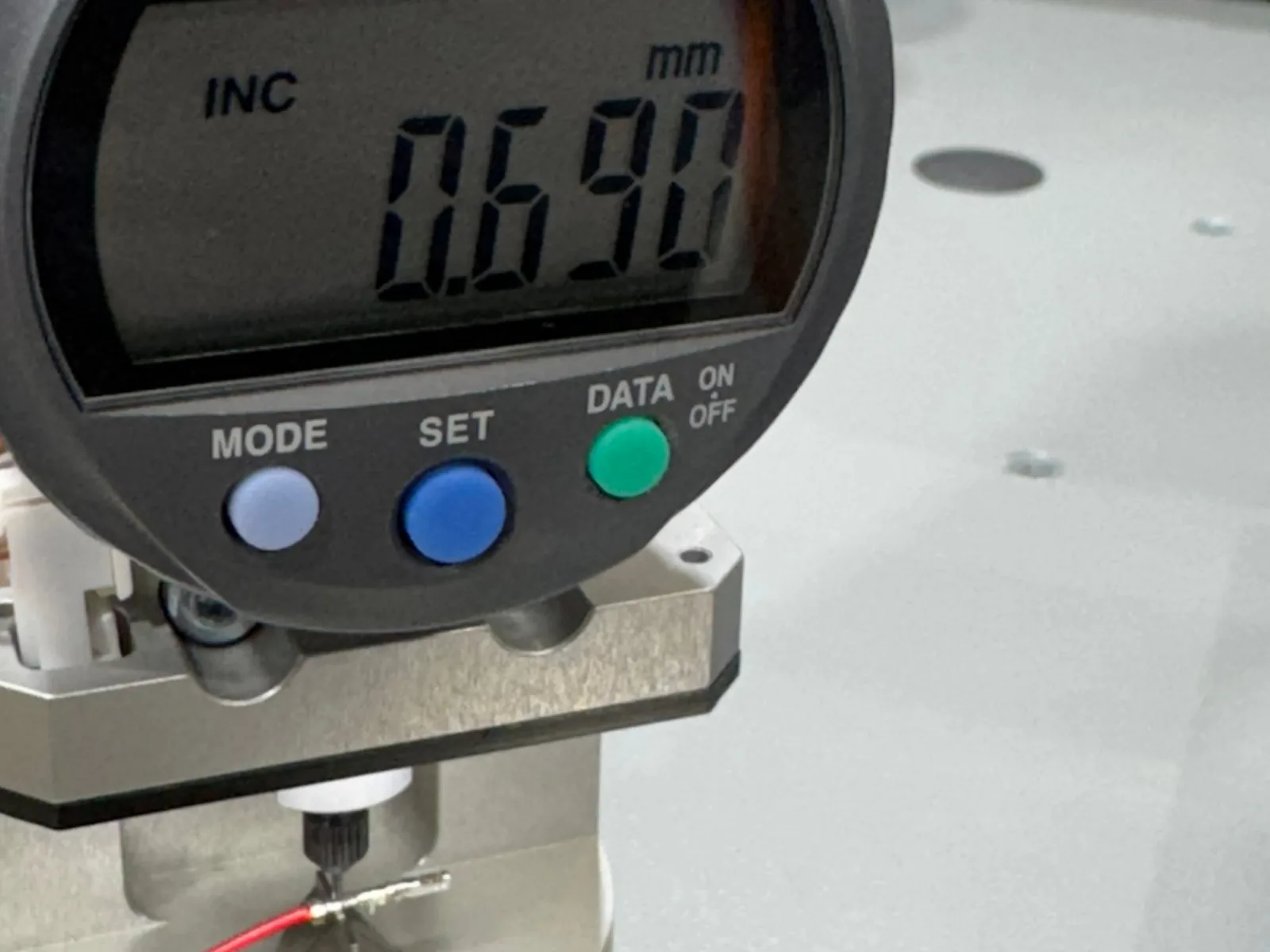
The crimp height is the most important dimension of a crimp. It is measured on the conductor crimp using a measuring device with special measuring tips and compared with the target value specified by the contact manufacturer. If it is too large, the conductor sits loosely; if it is too small, wires are crushed or damaged.
Pull-out force
In a pull-out force test, the conductor is pulled out of the crimp and the force needed to do so is measured. If it falls below the minimum value, the connection does not hold reliably. The test is destructive and is therefore carried out on a sample basis, during setup for example.
Micrograph
For a cross section micrograph, the crimp is cut transversely, ground and examined under a microscope. It shows whether the wires are evenly compacted, whether voids remain and whether the crimp flanks have closed correctly. Micrographs are typically produced when a new combination of contact and tool is released and for initial sampling.
Crimp force monitoring in series production
Because crimp height, pull-out force and micrograph only allow spot checks, in series production every single crimp is monitored through its force curve. If the curve deviates from the reference, for example because wires are missing or insulation has been crimped in, the cable is sorted out. At Powertune the fully automatic cable processing machine monitors every crimp in this way; we check the crimp height with a crimp height measuring device.