Crimping: cold, fast, reliable in the process
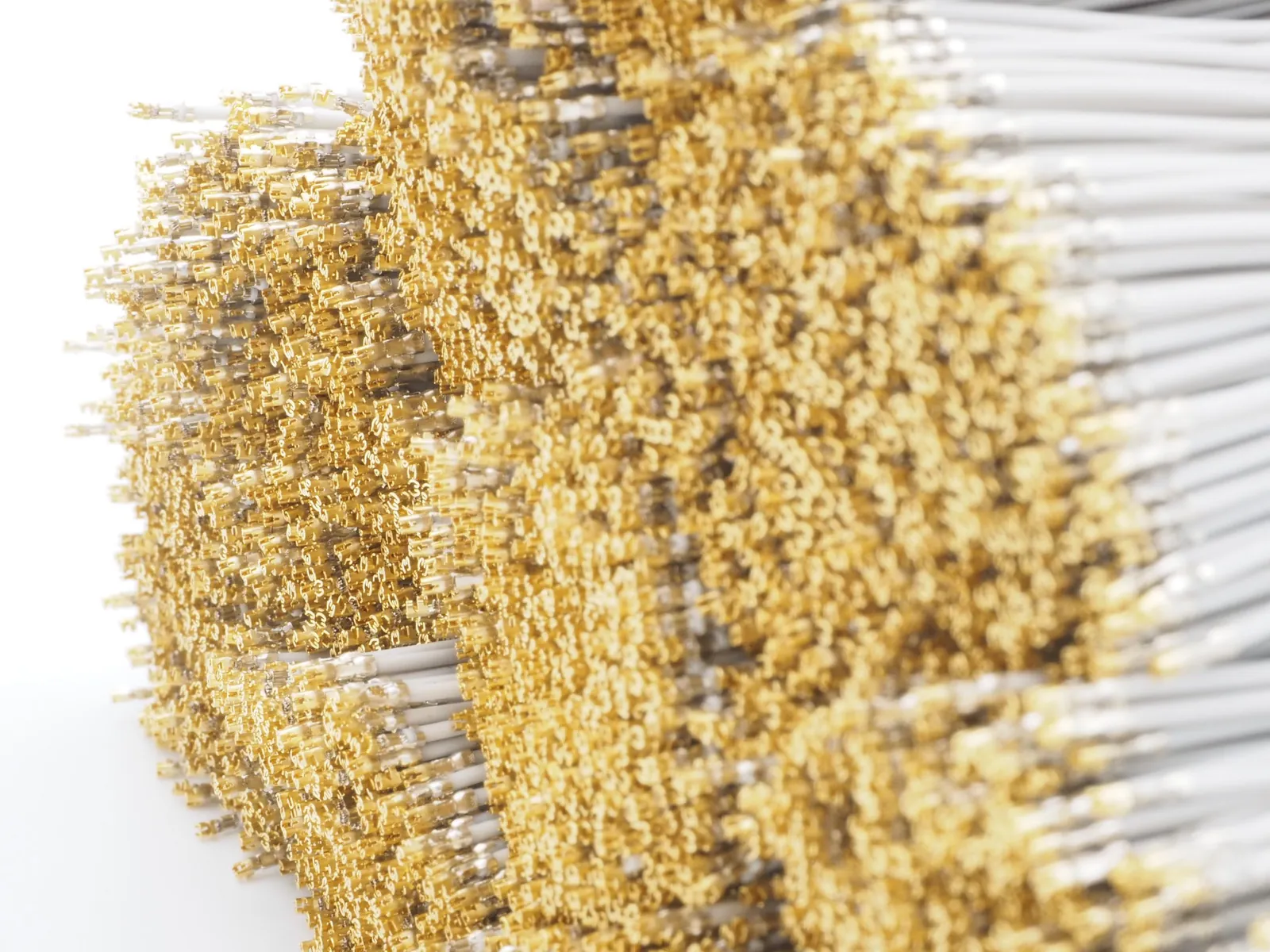
In crimping, the crimp barrel of a contact is pressed around the stripped conductor with a tool. Conductor and barrel deform plastically and form a tight, mechanically strong connection, without heat and without any added material. A second crimp usually encloses the insulation and acts as strain relief.
Crimping is the standard process in cable assembly because it can be automated and monitored in process: crimp force monitoring compares the force curve of every crimp with a reference, and the crimp height is measured. It requires the right contact, the matching tool and a conductor cross section that suits the contact.
Soldering: for solder contacts and printed circuit boards
In soldering, molten solder joins conductor and contact. That makes sense for solder contacts, printed circuit boards and some connectors. With stranded conductors that will later be exposed to vibration, caution is needed: the solder wicks into the strands and creates a rigid section where the strand can break under movement. As a rule, tinned conductor ends therefore do not belong in crimp contacts or screw terminals.
Soldering calls for experience, careful temperature control and, with electronic components, ESD protection. At Powertune, soldering and tinning are carried out at ESD protected workstations.
Ultrasonic welding: nodes without added material
In ultrasonic welding, strands are welded together by high frequency mechanical vibration under pressure. The result is a metallurgical bond that is very compact, without solder and without a sleeve. The typical application is the splice: an electrical node where several cables come together, for ground or power distribution in a wiring harness for example.
Quality depends on the right parameters for the cross section in question. At Powertune, ultrasonic splices are produced on a Schunk Minic III.
Which process for which job?
- Crimping: the standard for contacts in connectors, cable lugs and wire end ferrules (can be automated and monitored in process).
- Soldering: solder contacts, printed circuit boards and special cases. Stranded conductors in areas subject to vibration are better crimped.
- Ultrasonic welding: splices and nodes joining several cables (compact and without added material).
We decide which technique suits your project during design and engineering, depending on the contact, the cross section, the environment and the quantity.