Knowledge · Conversion
Converting AWG to mm².
AWG (American Wire Gauge) is a measure standardised in North America for the conductor diameter, or the conductor cross section, of electrical cables and stranded wires. In Europe, cross sections are given in mm². On international projects, drawings and data sheets a conversion is therefore often needed.
Calculator
AWG ⇄ mm².
Calculated from the AWG definition: d = 0.127 mm · 92(36 − n)/39, cross section A = π/4 · d². The standard cross section is the next larger metric cross section.
- Cross section
- 0.518 mm²
- Conductor diameter
- 0.812 mm
- Standard cross section
- 0.75 mm²
- Conductor of the AWG size
- Next larger standard cross section
- Bar: scale
Table
AWG conversion table.
The most common AWG sizes with their metric equivalents in mm², with practical examples for matching them to typical cable cross sections.
| AWG | Cross section in mm² | Metric equivalent in mm² | Conversion and comparison |
|---|---|---|---|
| 1 | 42.40 | 50 | AWG 1 → 50 mm² |
| 2 | 33.62 | 35 | AWG 2 → 35 mm² |
| 3 | 26.67 | ||
| 4 | 21.15 | 25 | AWG 4 → 25 mm² |
| 5 | 16.75 | ||
| 6 | 13.30 | 16 | AWG 6 → 16 mm² |
| 7 | 10.55 | ||
| 8 | 8.37 | 10 | AWG 8 → 10 mm² |
| 9 | 6.63 | ||
| 10 | 5.26 | 6 | AWG 10 → 6 mm² |
| 11 | 4.17 | ||
| 12 | 3.31 | 4 | AWG 12 → 4 mm² |
| 13 | 2.62 | ||
| 14 | 2.08 | 2.5 | AWG 14 → 2.5 mm² |
| 15 | 1.65 | ||
| 16 | 1.31 | 1.5 | AWG 16 → 1.5 mm² |
| 17 | 1.038 | ||
| 18 | 0.823 | 1 | AWG 18 → 1.0 mm² |
| 19 | 0.653 | 0.75 | |
| 20 | 0.518 | 0.75 | AWG 20 → 0.75 mm² |
| 21 | 0.410 | 0.5 | |
| 22 | 0.326 | 0.34 | AWG 22 → 0.34 mm² |
| 23 | 0.258 | ||
| 24 | 0.205 | 0.25 | AWG 24 → 0.25 mm² |
| 25 | 0.162 | ||
| 26 | 0.129 | 0.14 | AWG 26 → 0.14 mm² |
| 27 | 0.102 | ||
| 28 | 0.0810 | 0.09 | AWG 28 → 0.09 mm² |
| 29 | 0.0642 | ||
| 30 | 0.0510 | ||
| 31 | 0.0404 | ||
| 32 | 0.0320 |
Table values from powertune.de. Besides the cross section, the current carrying capacity of a cable depends on the type of installation, the ambient temperature, grouping and the insulation material. The conversion does not replace a proper design calculation.
Background
Why AWG counts backwards.
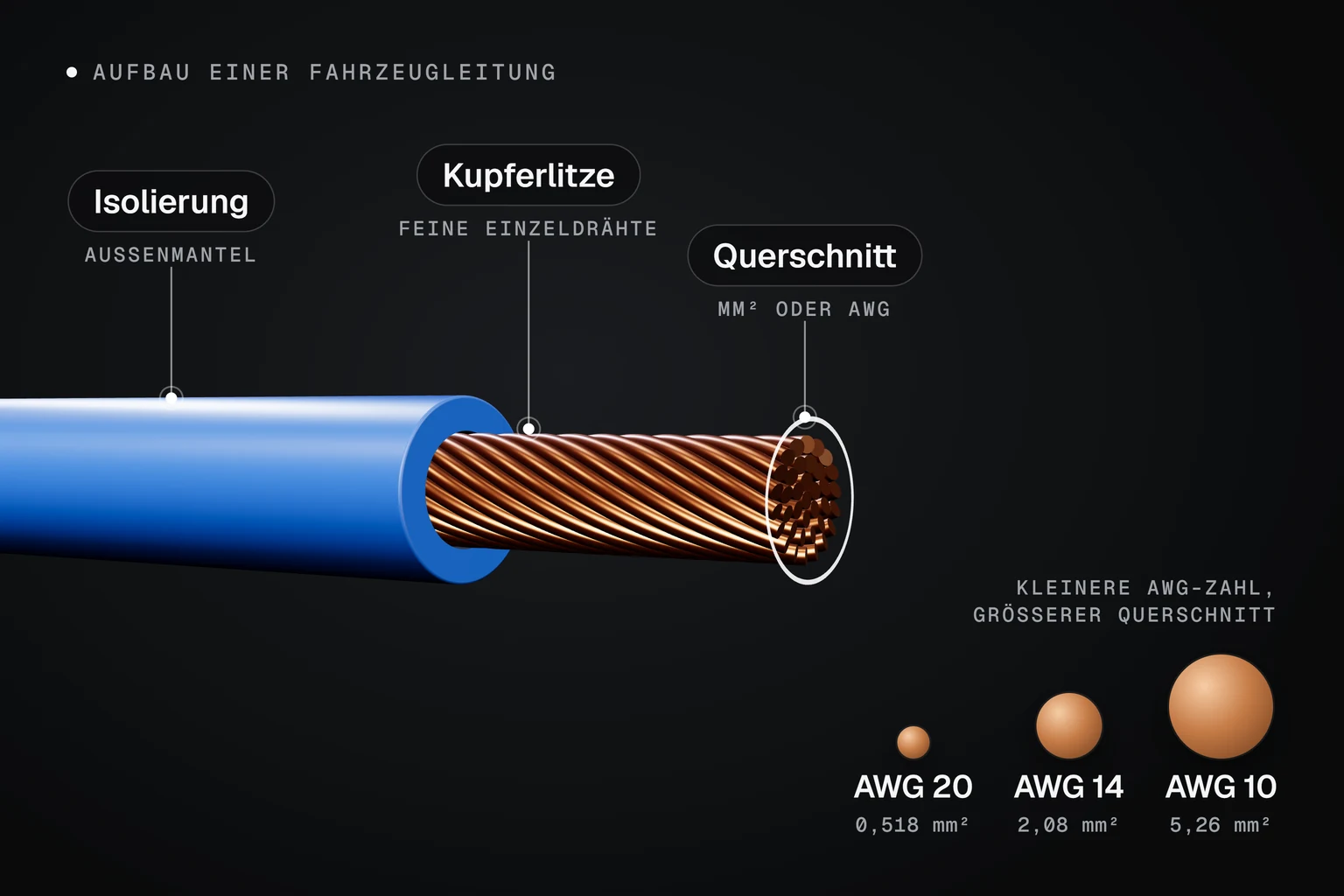
One particular feature of the AWG system: the numbering runs in the opposite direction to the conductor size. The smaller the AWG number, the larger the conductor diameter, the conductor cross section and the current carrying capacity: a cable with AWG 10 has a considerably larger cross section than a cable with AWG 20.
The AWG system is used in particular for single cores, connecting cables, cables and assembled cable sets. The conversion is needed above all in cable assembly, control cabinet construction, mechanical engineering, automation technology, electrical engineering and in international equipment manufacturing.
The sequence of numbers comes from wire drawing: the AWG number corresponds roughly to the number of drawing steps. Six AWG steps halve the diameter, three steps roughly halve the cross section.
Advice
Not sure about the cross section?
We advise you as early as the development phase on choosing suitable cables, connectors and protection systems.